He picked a future TN Ranji star one morning at Pachaiyappas ground, travelled to Bangalore and Bombay to watch his favourite player bat and chose his best cricketing partner when he could finally afford
20 First Division Titles, Over 60 tournament wins, 30+ International Players, 125 State Players and full time cricket employment to well over a 100 – A Phenomenal and Unmatched contribution to the development of cricket in TN over a long five decades period

As he was growing up as a teenager playing Tennis under the guidance of TK Ramanathan, it was more likely that he would become a tennis star in the future. There was no precedence to running a cricket club in a professional way. Cricket Management was never on the cards. Polio at 17 put paid to his Tennis ambitions and also ended the league cricket that he was playing at the time. As he made his way to the Illinois University in the US for his Masters in 1965, his thoughts would have been on management of the corporate business. Instead, on his return, he had an unlikely new engagement. Soon after he landed in Madras, he was off to the Pachaiyappas College ground and picked for his (second) team a fast bowler who would go on to play for Tamil Nadu for the next ten years. An unexpected cricket offer had come his father’s way a year earlier and that was to play a transformative role in the development of TN Cricket in the coming decades. His club won a record 20 first division championships, over 60 trophies overall in all formats of the game, 30+ cricketers from the club represented India and over 125 the State in domestic tournaments. The large heartedness of the man was seen this week from his spontaneous gesture to hand over a huge amount to 80 year old Najam Hussain, a star cricketer from the 1960s who has been struggling financially especially from medical challenges. Over the last four decades, he has also built his corporate group with diversified business interests into a billion dollar conglomerate.
As he turns 75 (Nov 19), here is the story of the man, who driven by his cricketing passion, pioneered the concept of professionally running private cricket clubs and one who has had the longest and the most successful stint in running a cricket club in the country.
A Tennis Star in the making
Chairman of The Sanmar Group N Sankar played cricket in the ‘gully’ (street cricket) off Gandhi Nagar Club in Crescent Park Avenue as a St Patricks school boy in the 1950s. When he moved into MCC School (Chetput), he began playing cricket a bit more seriously. In the early 1960s, he played league cricket for Jai Hind CC (the team is now ‘run’ by Sundaram Finance in the 6th Division) as an attacking batsman, a medium pace bowler and a ‘Slip’ catcher.

In that early phase as a teenager, Sankar was more inclined towards tennis than cricket and won a number of tournaments. His younger brother N Kumar too nourished ambitions of playing ‘serious’ tennis (that story will feature soon on this blog). Sankar was coached by TK Ramanathan in the late 1950s and early 60s. Tennis Legend 83 year old Ramanathan Krishnan (
https://prtraveller.blogspot.com/2015/03/ramanathan-krishnan.html), who recalls Sankar partnering with N Srinivasan to win the doubles tourney at Loyola, remembers the years when he was coached by his father
“Sankar was one of the favourite students of my father. Just like my father, Sankar too was an early riser and would come to the court very early in the morning, much ahead of others. He was quite talented and a ‘thinking man’ on court. In that phase, he had improved quite a lot and could have gone on to become a bigger player.”
However, polio struck when he was 17 and that put an end to his singles ‘career’ in tennis (Recently, this section featured a story on former CFO of Sundaram Finance S Venkatesan (
https://prtraveller.blogspot.com/2020/09/venkatesan-s-sundaram-finance.html) who was struck with Polio soon after birth that put him out of sports but fought all the way to a triple professional degree and rose to the position of Company Secretary and CFO of the NBFC). It put paid to Sankar’s Tennis ambition. After a year of physiotherapy, he got back to the tennis court partnering with N Srinivasan and the two won many doubles tournaments in that phase.

Krishnan vividly remembers his appa’s reaction on hearing the news “My appa was particularly fond of Sankar and admired his perseverance and hard work at such a young age. When Polio struck him, my appa was quite saddened as he saw him as a genuinely committed student with a willingness to learn and improve. He was of the view that Sankar would progress to the next level in Tennis but bad luck hit him at a time when he was emerging as a star player in the city, and the Polio strike brought about an early end to his Tennis aspirations.”
City cricket in the 60s
In the mid 1960s, VA Parthasarathy owned Jolly Rovers was run by S Rangarajan of The Hindu. Later to become Ranji Cricketer and Rangarajan’s nephew K Balaji played a ‘surprise’ league match for Jolly Rovers aged just 10 in 1965 (only in the last decade the minimum age limit to play in the TNCA league was fixed at 13!!) at the Vivekananda College ground in the last year that The Hindu ran the club. A majority of the clubs in the TNCA was run by individuals. Corporate involvement and professional running of cricket clubs were not yet in the realm of reality at that time.
Transformative Decision in 1966
It was against this backdrop that, in mid 1966, VAP approached KS Narayanan (KSN), MD, India Cements and asked if it would be possible for him to run Jolly Rovers. While Narayanan was passionate about cricket (his brother KS Raman was the only one in the family who had played some good cricket at that time - he played for Alwarpet and was the one who later promoted sports in Tirunelveli), he had had no thoughts about running a club in the TNCA league. His focus at that time was clearly on building the Cement firm. There was not too much money into the league clubs at that time and definitely not big corporate sponsorship. After much thought and in consultation with Ananthanarayan (Cost Accountant, India Cements), KSN nodded in the affirmative. It set the stage for the most transformative change in TN cricket, and life for the cricketers saw a sea change with the coming together of the father-son (KSN and Sankar) duo into cricket management.
Venkat and Prasanna bowling in Tandem in the TNCA league!!!
KSN did not take up the team to be ‘another ran’ in the TNCA league. While he debated with Ananthanarayan on the financial implications of such a call, once the decision had been made to go ahead, he was clear on running it as the best in the city and went about picking players accordingly. The who’s who of city cricket played for India Cements in that phase. S Venkataraghavan (
https://prtraveller.blogspot.com/2020/04/venkataraghavan75.html) was the biggest cricketing name in city circuit at that time having debuted in Test Cricket a year earlier and he fancied himself as a genuine allrounder in the Jolly Rovers team of the year. In fact, KSN immediately explored options outside the state. Mysore’s EAS Prasanna was almost picked but Ananthanarayan refused to accommodate the extra Rs. 25 (a big sum at that time) that the great offie looked for and thus the sight of watching two legendary offies bowl in tandem in the TNCA league was lost to the cricket fan.
A Truly Cosmopolitan Team
While the roping in of outstation players in the TNCA league gathered steam in the early 1990s, it was a revolutionary concept when KSN and Sankar initiated it way back in the 1960s, a move that left all other teams in the first division league in awe. They roped in two players from Services (PK Dharmalingam and V Balaji Rao), two from Karnataka (KR Rajagopal and Mir Najam Hussain), one from Andhra (KVR Murthy) and one from Kerala (B Kalyanasundaram (Kalli) – REC Calicut) in addition to the local flavour.
From The Hindu Archives - 1971
Picking Kalli at the Pachaiyappas ground for 2nd div team
Once Sankar came back to Madras in 1967 after his Masters in the US, while he was jointly involved with his father in the running of Jolly Rovers, he managed Jai Hind in the 2nd division (1B) all on his own. It was he who roped in Kalli into Jai Hind much to the initial ‘displeasure’ of the then Kerala Ranji cricketer.
Kalli(
https://prtraveller.blogspot.com/2011/08/kalli-b-kalyanasundaram.html) played Ranji cricket for Kerala when in his final year at REC and had performed exceedingly well. That morning at the Pachaiyappas College ground Sankar met Kalli and asked him to play for Jai Hind. Kalli had hoped for the first division team (Jolly Rovers) but Sankar brought to the notice of the 21 year old the bowling strength of Jolly Rovers that year and reasoned out that he was unlikely to get enough bowling opportunities to showcase his talent if he played for the senior side. Sankar recalls that morning’s meeting with Kalli
“He was not happy that I suggested a 2nd division team for he thought it would hamper his chances of a Ranji debut for Madras. I read out Jolly Rovers’ bowling list of the time and convinced him to play for a year for Jai Hind.”
Kalli accepted the offer and thus began his almost three decades long association with Sankar. He signed up for Jolly Rovers a year later and went on to become their star bowler and an integral part of the new ball attack that destroyed many an opposition in that phase, one when he performed with aplomb for TN in the limited bowling opportunities he got at a time when Venkat and VV Kumar (
https://prtraveller.blogspot.com/2007/07/cricket-tales-exclusive-with-vv-kumar.html) dominated the state bowling attack.
KSN’s infectious smile
Najam Hussain, who celebrated his 80th birthday last week (Oct 24), was an integral part of the Jolly Rovers team in those winning years when they won almost everything in sight. He remembers KSN as one with an Infectious Smile ‘He was ever smiling and ever loving. Not once in that phase did he ever frown. When he heard the news that eight of us at Jolly Rovers were selected for the State, he was on top of the world and his happiness was beyond description.”
Sankar’s all time favourite cricketer
Soon after watching KR Rajagopal bat, Sankar became his cricketing ‘fan’. Five decades later, the opener remains his all time favourite cricketer at Jolly Rovers. He remembers ‘Raja’ from that phase “He would come from Tirunelveli by train on the morning of the match, have his ‘Thayir Saatham’, wear his shoes and smash a brilliant century. He would then quietly return to Tirunelveli by train and get back to work after noon on Monday. In the five decades, I have not seen another like Rajagopal.”
In those days, cricketers’ commitment to work was high and they contributed both on and off the field. Najam Hussain remembers Rajagopal once working at the foundry till after 9am, changing into whites and scoring a blistering century at Chepauk that morning.
As Rajagopal narrates later in the story, Sankar was so fond of him that he went around the country watching his matches in a glorious phase for the opener in late 1967, one that ended in frustration.
PKD lets go Govt Pension, Joins Jolly Rovers
The excitement to play for Jolly Rovers was so palpable in those days that Services all rounder PK Dharmalingam(
https://prtraveller.blogspot.com/2015/06/pk-dharmalingam.html), who passed away in June last year, took a big financial call. He told this writer in 2015 at his home on Vedantha Desikan Street in Mylapore that he was so excited at the prospect of playing alongside the top cricketers that he quit IAF and lost his Pension there (as he quit two years ahead of his eligibility period) when he joined India Cements/ Jolly Rovers.

He recalled to this writer his double century (233) for Tirunelveli against Madurai in the SS Rajan Trophy after his move to India Cements Tirunelveli, one that still remains the top score. PKD was delighted to see their (KSN and Sankar) passion for cricket “I would alight at the Mambalam station and they would pick me up for the match in the car. Playing for them was a completely new experience for me in cricket and a delightful one at that”, Dharmalingam told this writer that day.
KS Kannan’s star act with the new ball
Former TNCA curator 68 year old K Parthasarathy, son of Jolly Rovers’ star new ball bowler KS Kannan, remembers the strength of that bowling attack after KSN and Sankar took over Jolly Rovers “As a teenager, I used to do 'scoring' for Jolly Rovers’ matches and in the process was excited to watch my father bowl. The MD of India Cements (KS Narayanan) and his son (Sankar) would come and watch every match. Their message to my father was to get early wickets with the new ball and my father responded almost every time. Even though the matches were only of one day duration, their bowlers would bowl out the opposition so quickly that they would win the match with time to spare.”
KSN bets on his team’s bowlers
It was that confidence in the team’s bowlers that led KSN to believe that they could achieve improbable feats against all odds. KSN and RN Chettur, Chief of IOB, another cricket crazy fan, used to watch league matches together, munching ‘Sundal and Kadalai’. TN’s hat trick man of the 70s Kalyanasundaram recounts an interesting episode involving the two of them during the semi final of the Buchi Babu Tournament at Loyola between Jolly Rovers (India Cements) and IOB.
In the first session, IOB had romped to 120/1. KSN drove back in his Plymouth for lunch. When he came back an hour or so later with Chettur, KSN found Kalli standing beneath a tree (and not on the field, bowling) and called for him. When Kalli narrated the tale of the play after lunch (Kalli had taken 7 wickets and IOB was bundled out for 145), KSN pulled Chettur’s leg in delight “In their drive back to the ground after lunch, KSN had bet that we would have bowled out IOB soon after lunch even though they had been just one wicket down at the luncheon break. He was laughed at by Chettur at this positive thinking of KSN, but after I shared the events of the hour after lunch, he congratulated KSN and shook him by the hand expressing delight at the strong team he had built.”
Reward for outstanding performance once made Venkat angry
In that early phase, outstanding performance was instantly rewarded. Every centurion and a bowler with a five wicket haul were handed Rs. 100 at the end of the match. It was a special moment for the players to get the reward personally from the top management. But Venkat was not always enthused by it. Once after he had taken 4 wickets, a catch was put down of his bowling. Venkat who set high standards for himself and the team even in those early days in the 1960s gave it his typical yell in anguish “I will give you that 100, take the catch that comes your way”.
Casatta Ice Cream, Buharis, Woodlands and Shanti Vihar
While centurions and bowlers with five wicket hauls were thus rewarded for their individual brilliance, the large heartedness of Sankar came to the fore when Jolly Rovers achieved tournament victories during the late 60s and early 70s. If it was a win at the Marina, the team landed up at ‘Marina Buharis’, a popular hangout then. On some of these trips, they would have an unlimited number of ice creams (Casatta was a favourite) and there were times when only a bit of the stick remained in the choco bar!!! A victory at the Vivekananda College ground and the destination was the then popular Shanti Vihar (now converted into a huge residential complex) at Luz in Mylapore. The reward for a special comeback win was a day out at Woodlands on Radha Krishnan Salai.
In each of these cases, it was a ‘No questions asked, just send the bill to the accounts’ kind of treat that was handed out to the players. It was the kind of motivation and reward that was not on offer anywhere else in the city with any other club “We had food to our heart’s content. The money that was spent on one lunch would have been the annual food budget for most other teams in the first division league” says Najam Husasin, looking back at the sumptuous meal they enjoyed in those years.
Great Spontaneous Gesture
Well, 50 years later, when this section wrote, last week, about the financial plight of Najam Hussain (
https://prtraveller.blogspot.com/2020/10/najam-hussain-80th-birthday.html) on the eve of his 80th birthday, Sankar sprung a surprise on Najam by immediately handing him a huge amount. Najam who referred to Sankar as ‘Sankaracharya’ when he met him in 2015 says that Sankar has always been one who wanted to see happiness in the faces of cricketers
“He has remained humble and down to earth all through the years despite the huge success he has enjoyed and has been so loving and caring. The treatment he meted out to us in those days was ‘brotherly’ and this spontaneous gesture now is so heartwarming at a time when my medical bills are mounting.”
As he looks back at those cricketing years in the late 60s and early 70s, Najam says that he would not exchange Jolly Rovers of that period with any other team or era or management.
Great Men in Spirit as well
It was not just financial motivation but they were also great in spirit. When Gavaskar, who had become a national hero after his record breaking performance in the West Indies in 1971, came to the city to play in the Buchi Babu tournament, thousands landed up at the ground to watch him bat. PT Raman Nair, Chief Justice of the Kerala High Court till September 1971 watched the match alongside KSN. Raman Nair’s son and Kalli were classmates at REC Calicut and soon after India Cements were bowled out for a low score, he called Kalli and threw a challenge to get Gavaskar in his first spell. Buoyed by the inspirational challenge, Kalli had Gavaskar edging the 2nd ball of the innings but much to his anguish (and the crowd’s delight), Balaji Rao dropped the catch. As it so often happens in cricket, the next ball was hit out of the ground for a six.
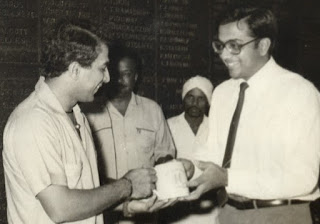
When a distraught Kalli came back for the tea break, KSN put his hand around him. Five Decades later, Kalli recalls that magic moment at Tea, words from KSN that were truly motivational “Do not worry. You got his (Gavaskar’s) wicket in spirit.”
Marina Crowd’s anger - Drive every player back home
Their humane gesture came to the fore at the end of another Buchi Babu tournament match. KR Rajagopal was the captain in the rain marred unfinished semi final against ACC in Marina that was decided by spin of the coin (Rajagopal called it right). The huge crowd that wanted to see international stars Umrigar, Gavaskar and Nadkarni, among others, in the final invaded the pitch after ACC failed to chase down Jolly Rovers’ modest score.
Talking to this writer from his home in Basavangudi, Bangalore where he has lived for the last 27 years, the 81 year old Rajagopal remembers the events of the day “As you know, Marina had a very small pavilion. Unmindful of that, both KSN and Sankar sat there next to the players and motivated us through the match. It just inspired each one of us that the top management of the firm was personally present. It was a big boost to us and we wanted to give it our best. When the crowd almost chased us in anger and began pelting stones, the two of them organised cars for all the players and ensured that each one of us were dropped home. It was just an amazing gesture. And they were even more thrilled when we won the final beating a strong State Bank side.”
Not only were they present at most of the matches, they also reached the ground on time. Kalli is embarrassed to recall that on many occasions, Sankar would be at the ground ahead of the players and that they had to hide themselves in shame.
Around the country to watch ‘Raja’ play
Rajagopal had been a star performer for Mysore in the first half of the 1960s. When he reached Madras in 1966, he set the city grounds alight with his dashing stroke play. 1967 was a special year as he was in the form of his life. He began with two Ranji Trophy centuries and was in the South Zone team for the Duleep Trophy as well as in the Rest of India team for the Irani Trophy match. The Octogenarian recalls Sankar’s trip to Bangalore and Bombay “It is unlikely one would have heard of a corporate chief travelling 400kms to watch his club cricketer play a domestic match and then another 2000kms to motivate him in another match, staying the full length of the multi day match in both instances. He was so passionate about the game and saw his club players as one from his own family. Every time we performed, we saw his eyes light up in delight and that spurred us to perform even better. For him to come and watch me play in Bangalore and Bombay was simply unthinkable. His presence was great inspiration for me and I wanted to showcase myself in front of him to make his trips worthwhile.”

After these performances in the Ranji, Duleep and Irani Trophy, Rajagopal was considered a certainty for the Australian tour end of that year but he was not picked with the selectors citing some frivolous reasons. Sankar was with him in those shattering days of Rajagopal’s life and remembers his frustration with cricket after he was unceremoniously left out of that tour despite amassing a wealth of runs early that season. Sankar was the one who repeatedly consoled his favourite batsman but found him to be never the same again and let go of his national ambitions that very day after what he heard from the selectors. In the 1980s, southpaw R Madhavan (
https://prtraveller.blogspot.com/2020/10/r-madhavan-tn-cricketer-1980s.html) had the same psychological feeling after being left out (of the England series) despite a strong domestic season and he too was never the same again for TN.
Sankar recalls the exact words of Rajagopal from that day “When the announcement came, he was shell shocked. He had performed in three different tournaments and he was almost unstoppable that year. He was so down that he simply shouted at himself with the remark ‘Po Da, Neeyum cricket um’. He almost packed off the cricket kit that day.”
Outside of Jolly Rovers’ KR Rajagopal, Sankar rates VV Kumar as the best cricketer he has seen “He just mesmerized the batsmen with his flight and turn. How sad he did not get to play more matches for India.”
The 1970s – The Cricketing Slowdown
After six glorious years, when Jolly Rovers won the Palayampatti shield five times, the club was rocked back in the 1970s. Sankar’s mother passed away and that was a huge setback for his father. It was also a challenging period for the Cement industry. Jolly Rovers’ fortunes turned south and the scenario had turned so bad that at one point of time they were on the verge of relegation.
Cricketers’ regard for Sankar
When Kalyanasundaram was coming towards the end of his Ranji Career (in the early 1970s, he was on the verge of India Selection and was even told to keep his kit ready for an overseas trip but like with many others of the generation from TN, the national call remained elusive and he had lost hopes of a test call by the mid 70s), the Engineer had a financially irresistible offer from LMW in Coimbatore in 1976. At the end of the interview with the founding family at LMW, the 30 year old Kalli threw a condition that shocked them. “I will go back to Madras and seek the blessings of Shri KSN and Shri Sankar on this move. Only if they consent, will I be able to join” Kalli told the LMW management.

It isn't like this anymore in the corporate world. The regard Kalli had for the two after his decade long engagement with them led him to 'seek' approval to make this move from cricket to a full fledged corporate career. He distinctly remembers the day when Sankar nodded his approval “He appreciated my gesture seeking his approval and it was with his full blessings did I accept the offer at LMW.”
Even after joining LMW, Kalli made the train trips from Coimbatore to play for Jolly Rovers. Interestingly, when health issues emerged in the 80s, Kalli rejoined Sankar and had an enjoyable almost two decade stint at Chemplast rising to the post of VP at the time of his retirement.
Revival of Jolly Rovers
Sankar, who was the Chief of Industrial Chemicals in the 1970s, took over as the MD of Chemplast in 1977. It was then that the running of Jolly Rovers moved to Chemplast from India Cements and Sankar orchestrated a great turnaround. Initially, he roped in a young team that brought the team from the bottom of the zone into the top half in two years. K Balaji(
https://prtraveller.blogspot.com/2020/09/a-blossoming-cricket-career-was-cut.html), who starred for TN in his first season in Ranji Trophy topping the batting charts in 77-78 and scored a top notch century in his 2nd season, moved to Jolly Rovers in 1979-80 with his childhood friend M Sriram as the captain.
Balaji recalls the performance of the young Jolly Rovers team in 1980-81 “Chemplast had laid a new turf wicket at the ‘home’ ground at University Union. While it was good for batting, the bowlers found it tough to get the opposition out twice to secure outright wins. Despite that, midway into the season, we were very much in contention for the top spot but our performance faded away in the second half.”
It was curator Parthasarathy who laid down the new turf wicket at Union for Jolly Rovers renewing his family’s association with the team.
“I will call you when I can afford you”
While Jolly Rovers through Chemplast was thus making a comeback into the top half of the first division league, Sankar eyed a man who was to go on to change the face of Jolly Rovers in the decades that followed. But it was not easy getting him. Wicket Keeper Bharath Reddy was in England the summer of 1979 with the Indian team under S Venkataraghavan and offers poured in from the top teams in the city league.
Sankar managed to finally rope in Bharath Reddy from SBI in 1982. He told this writer last year that he had wanted Bharath Reddy a few years earlier but could not afford his price tag at that time and had told him that ‘he would call him back when he could afford him’.
While he brought him as a captain, Sankar did not necessarily think that Bharath Reddy would turn out to be a man who would help Jolly Rovers reclaim the glory years of the 1960s. But Bharath immediately showed the mettle he was made of as Jolly Rovers won the Palayampatti Shield in his first two years as captain with a young team that was bereft of star state players. In the first year, he roped in lanky fast bowler TA Sekar (
https://prtraveller.blogspot.com/2013/08/ta-sekar-fastest-indian-bowler-of-1980s.html?m=0) who went on to make his Test debut in Pakistan later that season. And in the second year, he roped in 18 year old L Sivaramakrishnan (
https://prtraveller.blogspot.com/2016/04/l-sivaramakrishnan.html) who then went on to play a series winning role against England the next season. After this league success that had come over a decade after they had last won the 1st division title, Sankar made him the man in charge of the team and he just went beserk.

From The Hindu Archives 83-84 JR Team
During Bharath Reddy’s stint at Chemplast, Jolly Rovers has won the first division league a record 15 times. The understanding of the ‘partnership’ has probably been the single biggest factor in the success of this engagement that has now lasted close to four decades.
Balaji puts the contribution of Sankar (in recent decades with Bharath Reddy) in context “The trophies won by Jolly Rovers in different formats of the game and in diverse conditions make for an impressive record. But more important is the role the club has played over the decades in improving the lot of the humble Madras league cricketer, and in elevating his status from that of a mere company employee to that of a valuable resource. What set this group apart from the other patrons of the sport was the professionalism and consistency in finding cricketing talent and nurturing it.”

Sankar himself is hugely surprised at the way his association with Bharath Reddy has progressed “In terms of both success of the club as well as the length of the engagement, Bharath has far exceeded my expectations. With his brilliant networking and player management skills, he has done wonders for the club. In the 90s, he brought three outstation players, who were relatively unknown here in the city at the time of the signing and yet each of them played for the country within 12 months of their entry into Jolly Rovers. He just pulls them (hidden talent) out of the hat.”
In the second half of the 1980s, Sankar ideated an annual exchange between TN and Western Australia, the Sheffield Shield Champions of the time and a team that boasted of many test players. The winner picked up an expensive silver studded trophy. However, after two editions, the annual tournament fizzled out.
Graeme Wood with the Trophy
Vijay Sankar’s entry into cricket management
The phase also marked the entry of Sankar’s son Vijay, current MD of Sanmar Group, into cricket management. Parthasarathy remembers Vijay Sankar’s days at Chepauk as a young boy “KS Narayanan would walk around Chepauk, and on many days he brought along his grandson Vijay Sankar. While Narayanan did his walking rounds, he would often ask me to get Vijay on to the roller. I showcased the finer aspects of rolling the pitch and related activities to Vijay.”
While he did watch the league matches with his grandfather in those early years, it was only after the tied test in Madras and the 1987 World Cup that Vijay Sankar became active in team management. In that phase, in the late 80s and early 90s, this writer watched many a match in the first division with Vijay too being present at those matches. While crowds for the first division matches had dwindled by then, those few who came to the ground took immediate notice of Vijay’s presence and exclaimed ‘That’s Chemplast Sankar’s son”.
Guided by Bharath Reddy, he began to run and manage Kohinoor, a 2nd division team at that time (Sadagopan Ramesh and JR Madanagopal -
http://prtraveller.blogspot.in/2012/05/.-set-for-big-leap-as-umpire.html-played for the team). It was an active 6-7 year phase of cricket administration for Vijay. Ranji cricketer from the 1990s S Sharath played for Jolly Rovers through that entire decade amassing runs both for the club as well as the state. He remembers his time at Chemplast
“The professionalism in the way it was run is unmatched. Encouragement, motivation, cricketing infrastructure and personal care was always at its best at Jolly Rovers.”Sharath met with a serious road accident in the early 1990s and was admitted at the Malar Hospital “Through that challenging phase in my cricketing career, Vijay Sankar was there for me with personal visits to the hospital. His presence and constant monitoring was reassuring in that period.”
It was also Vijay Sankar who gave Sadagopan Ramesh (
https://prtraveller.blogspot.com/2014/11/sadhagopan-ramesh.html) that famous nick name ‘Lazy’ after watching him bat once in the early 1990s with the elegance of David Gower. That has stood with him ever since and the Ranji cricketers of the decade continue to address him by that name. Ramesh began his India career while he was at Jolly Rovers.
Offering Long Term Job Security to Cricketers
During that active phase in cricket, Vijay Sankar pursued Ramesh's elder brother S Mahesh(
https://prtraveller.blogspot.com/2020/08/s-mahesh-tn-all-rounder.html), who went on to play over 50 first class matches, for a long time to sign up for Jolly Rovers. Mahesh recalls those times
“No one pursued me in my two decades of cricket like Vijay Sankar did in that period. Unmindful that he was from the Management, he even came home to get my family to convince me to sign up. Not just the signing up for cricket, he even promised to the family that he would take care of me at Chemplast after my cricketing days and till my retirement.”
For reasons that his family is not able to come to grips even now, Mahesh remained firm and never played for Jolly Rovers in his career.
It was in that phase starting the late 1980s that Sankar initiated the thought of roping in outstation players once again. And the earliest ones, Jayakumar (the first oustation player in the 80s) as the Coach and Ajay Kudua, who scored 10 centuries against arch rivals Vijay/ India Cements, as a cricket manager, have stayed back for decades with Chemplast well after their playing days.
Over the five decades, Jolly Rovers has provided ‘cricketing employment’ to around 125 players.
Cricketers in the Corporate Set up
Among the star cricketers of the 1960s and 70s, Kalyanasundaram is the one who had the longest stint with Sankar (a decade with Jolly Rovers/India Cements and then almost two decades at Chemplast). He says once inside the corporate environment at Chemplast, there were no special privileges of having been a cricketer in the past and is all praise for the professional way the company was run “One had to remember that you have to consistently perform all the time to be in the reckoning. Familiarity or popularity has no place in the ranking of professionals.”
A larger role at the TNCA
As early as 1976, Sankar became a committee member of the TNCA. MA Chidambaram, who ran the show in that phase along with S Sriraman, was particularly fond of Sankar and respected his professionalism and the knowledge he brought into the meetings. Once, when a cricketer played for two teams in the league it was Sankar who suggested the creation of a unique id for all registrations. Initially the idea was scoffed at but when the aforesaid episode showed its head again, Sankar’s idea was implemented.
The two NS’ and its global cricketing impact
In the early 1990s, Sankar took over as the President of the TNCA after winning unopposed. He also roped in N Srinivasan (who had been out of cricketing action) as the VP of the TNCA and there was a real possibility at that time of the two working together. Had that happened, the TNCA may have become the strongest cricketing association in the world with the cricketing knowledge, administrative and management skills and their combined passion for the game. Had the cricketing environment been good, it is likely he would have stayed as the President for the time of his choice for there was no opposition at that time. Unfortunately what Sankar witnessed that year in the TNCA left him shocked and he has stayed away from the larger administration ever since (the full unfolding of the events of that phase at the TNCA will be kept for another day!!).
His one regret in cricket remains the failure to implement his grand vision for the TNCA and the cricketers.
Initiatives at TNTA
Between 1988 and 93, he was also active in the administration of the other sport that he so loved from his childhood. As the President of the Tamil Nadu Tennis Association (TNTA), he transformed the association in the five years that he was at the helm. Sankar looks back at those ‘Tennis’ years with a lot of satisfaction “The finances were improved quite a bit - the Association I inherited was bankrupt with a negative corpus. Several tournaments were conducted, the most prestigious of which was the Indian Bank Indian Classic Tennis Tournament”
“During my Presidency, the biggest achievement was streamlining and regularising the administration and operations of TNTA. We improved its reach and infused a lot more interest in it. We also expanded it to other age groups and ladies. It continues to be the best organised and most popular tennis league in the country.”
Record Titles in the 2000s
Since the mid 90s, after deciding to stay away from the TNCA, Sankar has focused on making Chemplast and Jolly Rovers the best of the lot in cricket. And he has easily achieved that in partnership with his cricket manager Bharath Reddy. Since the turn of the century, Jolly Rovers has featured in 15 first division league finals winning 10 of those. The club has not been in the final only thrice this century and that is an astounding record that Sankar can be proud of.
In this phase, Sankar set up, in memory of his father, a world class cricketing facility at the sylvan settings within the IIT Campus. It has been widely acknowledged over the last decade as one of the most beautiful grounds to play cricket. The players who have played for Jolly Rovers have always been lavish in their praise of Jolly Rovers' cricketing infrastructure, though the former India internationals, who had their formative years at Chemplast, refused to offer comments for this story, quite in contrast to the cricketers from the generations gone by.
Bharath Reddy looks back at his four decades association with Sankar with great contentment “I had many offers at the time. SBI had also won the 1st division three years in a row. I see it as a great blessing that he pursued me, and came back a 2nd time. It was his cricketing passion that made me nod to him. In the decades since, he has been a terrific boss who has always trusted me and given me complete freedom to run his team. He has been a father figure to me and one I respect the most in the world.”
In the most challenging of times, the Chemplast has actually added two more teams under its fold in recent years. In addition to Jolly Rovers, the firm also runs Alwarpet and MCC. However, after well over 35years of managing the cricketing operations, Bharath Reddy says that the joy is not there anymore in the current environment and his own cricket management days may be numbered “Vijay (Sankar) has always been passionate about cricket and I am confident that he will take over from Sankar. I will do everything in my fold to ensure a smooth transition to the next cricket manager.”
For Sankar, it has been a long and enjoyable cricketing journey “Cricket has given me a lot of pleasure. While there was not much money in the game back then in the 1960s and 70s, we enjoyed a great relationship with the players. They valued our presence at the ground. And winning the Palayampatti Shield was a big deal as was The Hindu Trophy and the Buchi Babu Trophy.”
Sankar’s Glorious Five Decades @ Jolly Rovers
As Sankar turns 75 this month, the cricketing passion is still there and the old memories of the glorious days from the 1960s linger. However, he is unsure as to how long this will last as he has been pondering his cricketing future for quite a while now. The finances have surged over the last decade. Currently, the investment into cricket is almost near the size of the company when Chemplast took over Jolly Rovers in 1977. The economics is working just fine for the moment, given that the team is continuing to enjoy major success.
Jolly Rovers has won the Palayampatti Shield 20 times in the last 53years that is a 40% success percentage, unmatched by any other club in the city. When he took over with his father in the second half of the 1960s, Jolly Rovers won the first division league 5times in the first 6years. And now five decades later, they have been in the first division final 6 times in the last 7 years, a remarkable achievement indeed, especially the longevity of success. While many of the nationally renowned private clubs of the 1970s and 80s such as Mafatlal, ACC and Nirlon that rose to popularity then have ceased to exist, the personal passion of this man, in partnership with Bharath Reddy, has kept this club still relevant and at the top of the city league five decades after he took over. Sankar is hopeful that his son, Vijay, who manages 13 companies in the Sanmar Group, would find the time to take over the sporting reins from him and carry this legacy, into the future.
While the cricket fan will eagerly await a decision on that one, this section salutes the man who provided a strong platform for many a budding talent to pursue his cricketing interest and one who has stayed through challenging times making a smooth transition through three different generations from the golden days of Octogenarians KR Rajagopal and Najam Hussain to the current set of teenaged cricketers for whom cricket has become a full fledged professional career.
This is wishing Sankar a Happy 75th Birthday, in advance (Nov 19).


