Showing posts with label Divya Desam in Andhra Pradesh. Show all posts

Tuesday, July 13, 2021

Ahobilam Yogananda Narasimha

Thiruvallikeni School boy and Narasimha devotee Prahladh spots the interchanged Yogananda Narasimha at Ahobilam Divya Desam - Officials now confirm the reversel of the idols during the Previous Samprokshanam
In May last year, this section had featured a story on 10 year old school boy from Thiruvallikeni and his devotional passion to hand sketch Narasimha idols (https://prtraveller.blogspot.com/2020/05/prahladh-devotional-drawing.html). A version of this story had also featured earlier in The Hindu Friday Review.

A couple of years ago, this writer had seen the young Narasimha devotee stand in front of the Yoga Narasimha sannidhi at the Parthsarathy Perumal Divya Desam in Thiruvallikeni and within hours sketching the Moolavar idol of Narasimha.

Prahladh spots the interchanged idols
In quite an unbelievable devotional absorption power, Prahladh, who visited the Ahobilam Divya Desam over the weekend spotted the interchange of Swayambu and Pratishta Murthy at the Yogananda Narasimha Sannidhi. Prahladh had been given photographs of the Sannidhi in its previous form and the current structure.  When he returned home on Sunday evening and began sketching the idol, he found something odd and his drawing came to an instant halt.

When Prahladh looked deep into the two photographs, he found that the Swayambu and Pratishta idols had been interchanged and his inquisitive instincts enquired as to how and why this had happened.
OLD YOGANANDA NARASIMHA SANNIDHI, AHOBILAM

Multiple officials related to Ahobilam that this writer spoke to over the next 48 hours were clueless that such a change had taken place. Ananthapadmanabhanchariar, Upanyasakar and Srikaryam of the Ahobilam Mutt, told this writer that he was not aware of any such changes to the Yogananda Narasimha Sannidhi.

Venu Srinivasan's Ahobilam Restoration but not of Yoga Narasimha Sannidhi
In November last year, this section had featured a story last year on Venu Srinivasan undertaking restoration of the Ahobilam Divya Desam (https://prtraveller.blogspot.com/2020/11/ahobilam-temple-restoration.html) but interestingly he had not performed any restoration work in the Yogananda Narasimha Sannidhi for the repair works had already been completed prior to his taking up the restoration work at Ahobilam. 
Sources say that the Jeer may have requested Venu Srinivasan to undertake the restoration work in the rest of the Ahobilam Divya Desam temples after seeing the 'modernised' work at the Yogananda Narasimha Sannidhi.

Tiled works and Modernisation of Yoga Narasimha Sannidhi
The Thiruvallikeni devotee also brought to this writer’s attention the modernization of the Yogananda Narasimha Sannidhis as compared to other sannidhis in Ahobilam - with the difference in the stone structure from the earlier period and now clearly visible..
NEW YOGANANDA NARASIMHA SANNIDHI -REVERSED IDOLS 
AND TILED BACKDROP

When contacted, a source related to Ahobilam who has been associated with the Divya Desam for the last two decades said that the renovation of the Yogananda Narasimha Sannnidhi had been performed a Mutt Sishya as a one off exercise and that this had indeed been completed before Venu Srinivasan took up the works at the Divya Desam.

Clearly, in the one off exercise, one finds tiles replacing the ancient stone structure at this sannidhi.

Historical Background to Prathista Idol
Between 1995 and 98, the Swayambu Idol of Yogananda Narasimha had been damaged. The Power Agent of the time had directed and organised a Prathista Murthy to be sculpted.  Till then, there had been only the Swayambu Idol at the Yogananda Narasimha Sannidhi.

When the then Jeer of the Ahobilam Mutt came to know of this development, he ordered that the Swayambu Idol cannot be done away with and directed the repairs of that historical idol. During the 1998 Samprokshanam, both the idols were consecrated. At that event, the Swayambu idol was in the front while the newly sculpted Prathista Murthy was in the background.

Recently, when the consecration of the Yogananda Narasimha Sannidhi took place after the repairs exercise by the private donor, the idols were swapped and one now finds the Swayambu Idol at the back and the Prathista Murthy in the front. Agama experts say that the current order of placement of the two idols is the way it should have been in the original instance.

On Tuesday evening, the official of the Divya Desam confirmed to this writer that the idols were indeed interchanged in the recent Samprokshanam.

Hats off to the 11 year Prahladh for spotting the change!!! It indeed is a reflection of his devotion for Narasimha and his attention to minute details while sketching his favourite Narasimha drawings on a white sheet of Chart paper.

Monday, November 16, 2020

Ahobilam Temple Restoration

Venu Srinivasan has shifted his focus North of Tamil Nadu to Ahobilam to carry out a ‘Srirangam’ style extensive restoration of the Thiru Mangai Azhvaar Praised Divya Desam
In the last 50 years, new and unwanted constructions had come up within the temple complex and many historical structures were seen in a dilapidated state
Earlier this decade, in a matter of 18 months, Venu Srinivasan under the direction of the then CM of TN J Jayalalitha undertook what was to be a once in a century restoration of the Ranganathaswamy Temple in Srirangam(https://prtraveller.blogspot.com/2017/11/venu-srinivasan-srirangam-temple.html). It was transformational because in the 75 years preceding the renovation, almost every single sannidhi in the temple had seen unwanted additional construction that took away ventilation and made every Sannidhi dark and congested. Most of the Sannidhis remained shut. The restoration exercise saw every single such new construction being brought down and the sannidhis brought back to its historical glory in terms of architectural beauty. Today, every Sannidhi is open each day of the year.

Last year, this section had pointed out the drastic reduction in  restoration exercises (https://prtraveller.blogspot.com/2019/02/renovation-issues-in-tn-temples.html) in recent years in TN, following the intervention of the court. Several hundreds of temples in the state, including remote ones, have been waiting for approvals from the court appointed committees but those have been easily forthcoming. Many temples have, much to their dismay, found devotee donors going away elsewhere with the contributions.

Venu Srinivasan himself has a couple of big restorations pending in his list in Tamil Nadu, those have been on hold for quite sometime now. For the moment, he has moved North of the state, to Ahobilam Divya Desam,  located just over 100kms North West of Cuddapah. With the lifting of the lockdown restrictions, he has just begun a large scale restoration initiated there for the first time in almost 50 years under the blessings of the Jeer of the over 600 years old Ahobilam Mutt.The scenario at Ahobilam was no different from what the one that existed in Srirangam prior to the commencement of the activities. Since the last large scale repairs work organised in 1974, there has been extensive additional construction within and outside the temple complex in lower and upper Ahobilam.                

It was the Ahobila Narasimha cave temple in Upper Ahobilam (about 8kms from Lower Ahobilam) at the foot of Garudathri about 3000feet above sea level that Thirumangai Azhvaar visited and sung praise referring to this location in his verses as Singavel Kundram. The difficulty of visiting Singavel Kundram can be seen from this verse of Thirumangai where he says that it is almost impossible to reach this temple as this is a rocky terrain with constant forest fires and the presence of bow wielding hunters.

முனைத்த சீற்றம் வின்சுடப்போய் 
மூவுலகும் பிறவும்
அனைத்தும் அஞ்ச ஆள் அரி ஆய் 
இருந்த அம்மானது இடம்
கனைத்த தீயும் கல்லும் அல்லா
வில் உடைய வேடரும் ஆய்
தினைத்தனையும் செல்ல ஒண்ணாச்
சிங்கவேழ் குன்றமே

Ahobila Narasimha is seen in an Ugra Posture with Prahalada standing opposite to him. The Utsava deity of Ahobila Narasimha Divya Desam is seen at the Lakshmi Narasimha Prahalada Varadan temple at Lower Ahobilam. 

12/24/36 Pillar Mandapams – Restoration
Within three months of beginning the restoration exercise, there has been a sea change at this Divya Desam. Just ahead of the lockdown, the 24pillar mandapam at the entrance arch was seen with huge amount of debris with the structure having gone down. After removal of the debris and work around the structure, the mandapam has been brought back to its historical best.
Worse was the state of the 12 Pillar Mandapam. Rubbles surrounded the Mandapam that was seen in an unattended state. A good portion of the mandapam had sunk below the earth. After the first phase of work as one sees it in Karthigai, it is almost unrecognizable. 

The 36 Pillar Mandapam and the Sasana Mandapam are no different. The bottom part of the Mandapams has not been visible with huge quantity of mud and debris that had collected over several decades. In fact, those visiting the divya desam in recent times would not have been aware of the historical nature of this architecture. The work is now under progress to reflect the foundation of the mandapams in its historical beauty. While the base of the Sasana Mandapam had gone below, the flooring and roofing were in dilapidated conditions. Stones were seen in broken condition and these have been replaced. A new weathering course has been initiated on the roof of the Mandapam. 

Deterioration over 50 years
To get a feel of how the Divya Desam had deteriorated in terms of its architecture, one only had to visit the Ramanuja Sannidhi in Ahobilam. There was a thick growth of shrubs, the sannidhi had gone beneath, the path leading to the Sannidhi was strewn with rough stones and the sannidhi complex itself provided a forlorn look. Subsequent to the activities undertaken over the last three months the Ramanuja Sannidhi and around stand transformed. Even as one looks at it from a distance, one can feel the historical nature of the Sannidhi.
Before and Now - The Transformation

Dilapidated Theppakulam Mandapam/Pavement
The pavement around the Theppakulam pointed to the dilapidated state of various zones at the temple complex. The west entrance had remained shut for a long time, the south side was full of shrubs and the west mandapam was in a dilapidated condition. Repair works around the Theppakulam over the last quarter has reopened this entrance and provided a facelift to the entire zone. There is beautiful greenery on the South side reminding one of similar restoration near the 1000 pillared mandapam in Srirangam.
Theppakulam - the old pillars earlier and the restored pathway, now
9 Forms of Narasimha
Narasimha is said to exist in one of the nine forms- Ugra, Veera, Jwala, Sarvamukham, Nrisimha, Bisanam, Bhadram, Mrityu and as Vishnu (Lakshmi Narasimha). It is only here at Singavel Kundram that one is able to see him in all the nine forms in a single location. As there are nine Narasimhas here, this place is also referred to as Nava Narasimha Kshetram. As Garuda undertook penance at the mountain here, this is called Garudachalam.  Every month on Swathi, there is a special Abhishekam for all the nine Narasimhas.

Dwajarohana Mandapam - Debris and Buried
Another zone in the temple complex that exposed the deterioration over the last half a century was the Dwajarohana Mandapam. This too like the above mandapams had submerged and gone below. With the removal of the mud that had built up near the mandapam, this too has been restored and original stone structure around the Mandapam is now clearly visible.
Submerged under mounds of mud - And Now

Cashing in on devotees’ prasadam craze
The Laddu Counter, and this is typical of most of the historical temples, is a prime example of how new constructions have come up inside temple complexes of late, to cash in on the popularity of the ‘prasadam’. The new construction is being dismantled and a traditional open stall is being set up.

Huge complexes relating to Anna Dhanam sheds, the provisions storage and the devotee toilets had all been built within the temple complex. These are being shifted outside of the prakaram into more acceptable zones.
                             Laddu Stall and Anna Dhanam Shed - New Accretions

In the first prakaram, new flooring had meant that historical epic carvings lay hidden and unseen. The Flooring has been restored and the entire stone carving that date back several centuries are now clearly visible to the devotees. In the second prakaram, a stone mandapam lay completely hidden with big sized new constructed that had converted it into rooms and offices. These additional constructions have been brought down and the mandapam restored to its historical grandeur.

White and Red Paints on the Mathil
Another common feature seen in almost all the historical temples in the last few decades has been the painting of the ‘Mathil’. Across the entire temple complex, the new styled paintings have been removed and the temple walls now have the historical look to it.

The Vahanam and Alankara Mandapams are also being restored. As with many of the temples, the madapalli is often a discarded area with new modern innovations. The current exercise also involves restoring the madapalli. In all the mandapams, roof leakage is being arrested by using traditional weathering course and pressed tiles. New  electrical facilities will be installed in the entire premises. In addition to these, rain water harvesting systems will be introduced around the temple complex.

Upper Ahobilam
Vishnu took the form of Narasimha (half man-half lion) in this mountainous terrain to kill Asura Hiranyakashipu. The pillar – Ugra Stambha- out of which Vishnu came out in his Narasimha Avataar is seen at the top of the Nalla Malai forest, about 7kms above the Upper Ahobila Divya Desam.
Thiru Mangai Azhvaar begins by praising Narasimha's physical strength and his special appearance in a half man-half lion posture and tearing Asura Hiranya’s chest while the world looked awe struck at his power and ability to destroy the Asura.
அம் கண் ஞாலம் அஞ்ச அங்கு ஓர் ஆள் அரி ஆய் 
அவுணன் பொங்க ஆகம் வள் உகிரால்
போழ்ந்த புனிதன் இடம்

பைங்கண் ஆனைக் கொம்பு கொண்டு பத்திமையால்
அடிக்கீழ்ச் செங்கண் ஆளி இட்டு இறைஞ்சும்
சிங்கவேழ் குன்றமே

It is one of the most exhilarating experiences to make the trip across rocks and water falls to reach the top of this mountain. While it is not an easy task, especially as there is no straight path or steps (unlike a Sholingur), a sincere devotee whose thoughts center around the Lord will be able to make it to the top of this mountain in about 2hours from Ahobila Narasimha temple.
Red Blood of Lord Narasimha
2kms below the Ugra Stambha and 5kms above Ahobila Narasimha Divya Desam is the Jwala Narasimha temple, the exact place where Narasimha tore open Hiranyakashipu. This temple is in a very scenic location, mountains on all sides, with the water fall just about 50yards away. To this day, one can see the red blood below the rock signifying the Hiranya Samharam. At the Jwala Narasimha Sannidhi, one finds Lord Narasimha in the middle in a fiery sitting posture here with 8hands. With a couple of hands, he is seen tearing open Hiranyakashipu and with another two, he is seen holding the Conch and Chakra. 

The developments at Upper Ahobilam is no different to the one below. New additions, Polished granite flooring, shutting out of light and ventilation in most mandapams with the construction of closed walls all around. As with Lower Ahobilam, there too the ‘accruals’ of recent decades have been removed, the polished floors replaced with traditional stones and all the mandapams restored to what it once were.

Festivals 220days a year
There are several inscriptions inside both the Lower and Upper Ahobilam temples. 14th Century inscription records the construction of the steps at the Upper Ahobilam (Divya Desam) temple. A 15th century inscription reveals the gifting of the village (Kaluvacheru- Komaragiripuram) by Karama Reddi for the conduct of the daily rituals and worship at the Divya Desam. A mid 16th century inscription reveals the contributions made by Vijayanagar kings. Kakatiya kings also contributed to the improvement of the temple and the mandapas. Inscriptions relating to the 16th century provide insights into the building of mandapam, Garuda Stambha and festivals on 220 days in the year. Another interesting inscription refers to ‘Thaligai’ to be presented to the Lord twice a day- once at noon and the other in the evening at the Lower Ahobilam temple. Krishna Deva Raya, who sought the blessings of Ahobila Narasimha before going for a battle, came back after having won the battle and installed the Vijaya Stambha in front of the temple here.

Every year, a 12day Brahmotsavam is celebrated in a grand way in Panguni.
While in every large scale restoration exercise including Nava Tirupathi and Srirangam, there has been an initial apprehension and resistance, Venu Srinivasan has found a lot more openness in temples in Karnataka and Andhra Pradesh. The appreciation of the months of  hard work in restoring the nine Narasimha temples in Ahobilam to historical glory has found resonance in the people there. And that for the moment is motivating enough for him to carry on  such large scale restoration work well past the 25th year (https://prtraveller.blogspot.com/2020/07/venu-srinivasan-historical-temples.html)

This section will track further the restoration developments at Ahobilam over the next few months.

Friday, February 25, 2011

Nava Narasimha Ahobilam

Bharghava Narasimha


6kms from Lower Ahobilam is Bharghava Narasimha temple. One has to go through a rugged muddy road to the foot of the temple and then climb 130steps to reach the temple.

Parasurama while on his theertha yatra reached here and wanted darshan of Narasimha. Answering his prayers, Lord Narayana presented the Dasavathara display. Narasimha is seen here in his Hiranya Samhara posture.

Yoga Narasimha


On completion of Hiranya Samhara, Narasimha came here to the west of Lower Ahobilam and rested in a yogic posture. It was here that he initiated a few yogic mantras to Prahalada.

Chatravada Narasimha


Half a km East of Yoga Narasimha is Chatravada Narasimha, the most handsome of the Nava Narasimha temples. At the end of the Hiranya Samhara, Narasimha was in an angry state. In an effort to cool him down, two Gandharva musicians, Aaha and Oohoo are said to have played music. Pleased with their music, a happy Narasimha is believed to have patted on his lap tapping in to their music.
In recognition of their role, one finds their sculptures at this temple.

Pavana Narasimha
This is the most difficult of the nava narasimha temples to reach. One will have to take special jeep to reach this temple or walk through a tough 6hour trip across a rocky terrain to reach this temple.

Returning after the completion of Hiranya Samhara, an angry narasimha’s eyes fell on the beautiful Senjulakshmi of the Ahobilam hills. Lured by her beauty and wanting to marry her, he displayed his love by searching the entire hilly region to find non vegetarian food for Senjulakshmi, a resident of this place.

In memory of this event, every Saturday, the residents of this region present a hen as food to Lakshmi Narasimha at this temple.

Lakshmi Narasimha is seen in a seated posture with serpant God atop him. Lakshmi is seen sitting on his left lap.

Malola Narasimha
After Hiranya Samhara, this is the place where narasimha got back together with Lakshmi once again. He is seen with his left leg folded, his right leg hanging down with Lakshmi on his left lap.

Malola Naraimha, the utsava deity, is the processional deity of Ahobila Jeer.

Wednesday, October 27, 2010

Ahobilam Singavelkundram

Thirumangai Azhvaar in his Periya Thirumozhi refers to this place as Singavel Kundram and says it is almost impossible to visit because of the rocky terrain 
Located about 110kms North West of Cuddapah amidst the dense Nalla Malai Forest of the Achalachaaya Meru mountain range is the Singavelkundram Divya Desam in Ahobilam, one of the 16 prominent Swayam Vyaktha Kshetrams. Reference to Ahobilam is found in 10 chapters (over a 1000slokas) in the Brahmanda Purana. 

Divya Desam- Upper Ahobilam 
It is the Ahobila Narasimha cave temple in Upper Ahobilam (about 8kms from Lower Ahobilam) at the foot of Garudathri at about 3000feet above sea level that Thirumangai Azhvaar visited and sung praise referring to this location in his verses as Singavel Kundram. Ahobila Narasimha is seen in an Ugra Posture with Prahalada standing opposite to him. Narasimha came and stayed here as a hunter and being away from Goddess Lakshmi, married Senjuga Thaayar, who was born and brought up here. Hence, at the Upper Ahobila Narasimha temple, one finds a separate sannidhi for Senjuga Thaayar. The Utsava deity of Ahobila Narasimha Divya Desam is seen at the Lakshmi Narasimha Prahalada Varadan temple at Lower Ahobilam. Bhavanasini River flowed here so Narasimha could clean his hands after the Hiranya samharam. 
Narasimha Avataara Sthalam 
 While Ayodhya is the Avataara Kshetram of Rama and Mathura is the Avataara Kshetram of Krishna, Ahobilam is the place of incarnation and the Avataara Kshetram of Narasimha. This is the shortest of his Avatharams and unlike other avatharams, this one was taken for the sake of one person (Prahalada) answering his sincere prayers.

The name 
This place is popularly referred to as Ahobilam.Thirumangai Azhvaar in his Periya Thirumozhi refers to this  as Singavel Kundram. As there are nine Narasimhas here, this place is also referred to as Nava Narasimha Kshetram. As Garuda undertook penance at the mountain here, this is called Garudachalam. After seeing Narasimha tear apart Hiranyakashipu, the Devas are believed to have exclaimed ‘Aaha’ ‘Balam’ (supreme strength of the Lord). Hence this place came to be known as Aho-Balam. As this is a cave temple, the place also came to be referred as ‘Aho’ ‘Bilam’(cave). 

Nine Forms of Narasimha 
Narasimha is said to exist in one of the nine forms- Ugra, Veera, Jwala, Sarvamukham, Nrisimha, Bisanam, Bhadram, Mrityu and as Vishnu (Lakshmi Narasimha). At any of the Narasimha temples, one would see the Lord in one of these forms. It is only here at Singavel Kundram that one is able to see him in all the nine forms in a single location. (more on each of these nava Narasimhas in a seperate story) 
The Story 
Vishnu took the form of Narasimha (half man-half lion) in this mountainous terrain to kill Asura Hiranyakashipu. The pillar – Ugra Stambha- out of which Vishnu came out in his Narasimha Avataar is seen at the top of the Nalla Malai forest, about 7kms above the Upper Ahobila Divya Desam. It is one of the most exhilarating experiences to make the trip across rocks and water falls to reach the top of this mountain. While it is not an easy task, especially as there is no straight path or steps (unlike a Sholingur), a sincere devotee whose thoughts center around the Lord will be able to make it to the top of this mountain in about 2hours from Ahobila Narasimha temple. 

The difficulty of visiting Singavel Kundram can be seen from this verse of Thirumangai where he says that it is almost impossible to reach this temple as this is a rocky terrain with constant forest fires and the presence of bow wielding hunters. 
முனைத்த சீற்றம் வின்சுடப்போய் 
மூவுலகும் பிறவும் அனைத்தும் அஞ்ச ஆள் அரி ஆய்
இருந்த அம்மானது இடம் 
கனைத்த தீயும் கல்லும் அல்லா 
வில் உடைய வேடரும் ஆய் 
 தினைத்தனையும் செல்ல ஒண்ணாச்
 சிங்கவேழ் குன்றமே - Thirumangai Periya Thirumozhi

Red Blood of Lord Narasimha  
2kms below the Ugra Stambha and 5kms above Ahobila Narasimha Divya Desam is the Jwala Narasimha temple, the exact place where Narasimha tore open Hiranyakashipu. This temple is in a very scenic location, mountains on all sides, with the water fall just about 50yards away. To this day, one can see the red blood below the rock signifying the Hiranya Samharam. At the Jwala Narasimha Sannidhi, one finds Lord Narasimha in the middle in a fiery sitting posture here with 8hands. With a couple of hands, he is seen tearing open Hiranyakashipu and with another two, he is seen holding the Conch and Chakra. The left leg is seen in a folded posture and the right leg hanging on the ground. Prahalada is seen at the feet of the Lord in a praying posture. On the right, one finds Narasimha engaged in the battle with Hiranya. 
Garuda's Penance 
With Lord Vishnu taking a sudden trip to this place to fight Hiranyakashipu, he decided to come on his own leaving behind Garuda at Vaikuntam. Hence, Garuda who normally plays the role of the Lord’s vehicle had to miss the Narasimha Avatar. Unhappy with this, Garuda undertook severe penance in this mountain. Answering his prayers, Lord appeared here as Jwala Narasimha and provided Darshan to Garuda. As per the wishes of Garuda, this Kshetram has been referred to as Garuda Kshetram and the mountain is called Garuda Chalam or Garudathri. In Kritha Yugam, Lord Shiva performed pooja here and praised Narasimha as the Supreme Being uttering the Mantra Raja Mrutha Stotram. In Tretha Yugam, in search of Sita, Rama visited this place and worshipped Ahobila Narasimha singing praise on the Lord in 5 verses - Narasimha Pancha Mrutha Stotram. In Dwapara Yugam, the Pandavas reached Ahobila kshetram and invoked the blessings of Narasimha. In Kali Yugam, Srinivasa of Tirupathi presented ‘Thaligai’ to Lord Narasimha of Ahobilam prior to tying the knot on Padmavathi Thaayar. Adi Sankara who was attacked by evil forces here at Ahobilam praised Narasimha through the Karavalamba Stotram for protecting him. He also installed a Siva Lingam at the Ahobila Narasimha temple. 
   
Visiting three temples
In an earlier story on Narasimha temples around Villupuram, one had seen as to how it was sacred to visit Singiri, Poovarasan Kuppam and Parikkal in a single day. (http://prtraveller.blogspot.com/2009/08/poovarasan-kuppam-narasimha-temple.html) Legend has it that Adhiseshan’s presence is spread across this entire region with his head resting in Tirupathi, his body here at Ahobilam and the tail at Srisailam. The belief is that it is sacred to visit these three temples in one go. 

  Inscriptions-festivals 220days a year 
There are several inscriptions inside both the Lower and Upper Ahobilam temples. 14th Century inscription records the construction of the steps at the Upper Ahobilam (Divya Desam) temple. A 15th century inscription reveals the gifting of the village (Kaluvacheru- Komaragiripuram) by Karama Reddi for the conduct of the daily rituals and worship at the Divya Desam. A mid 16th century inscription reveals the contributions made by Vijayanagar kings. Kakatiya kings also contributed to the improvement of the temple and the mandapas. 
Inscriptions relating to the 16th century provide insights into the building of mandapam, Garuda Stambha and festivals on 220 days in the year relating to the Lower Ahobilam temple. Another interesting inscription refers to ‘Thaligai’ to be presented to the Lord twice a day- once at noon and the other in the evening at the Lower Ahobilam temple. Krishna Deva Raya, who sought the blessings of Ahobila Narasimha before going for a battle, came back after having won the battle and installed the Vijaya Stambha in front of the temple here. Ramanuja and Vedanta Desigar are believed to have visited this temple. 

Azhvaar Praise Thirumangai Azhvaar begins the first of his 10verses on Singalvel Kundram by praising Narasimha's physical strength and his special appearance in a half man-half lion posture and tearing Asura Hiranya’s chest while the world looked awe struck at his power and ability to destroy the Asura. 
அம் கண் ஞாலம் அஞ்ச அங்கு ஓர் ஆள் அரி ஆய் 
அவுணன் பொங்க ஆகம் வள் உகிரால் 
போழ்ந்த புனிதன் இடம் 
பைங்கண் ஆனைக் கொம்பு கொண்டு பத்திமையால் 
அடிக்கீழ்ச் செங்கண் ஆளி இட்டு இறைஞ்சும் 
சிங்கவேழ் குன்றமே 

Ahobila Mutt 
In the late 14th Century, the Lord is said to have initiated Adivan Sadagoopan to launch the mutt here at Ahobilam to propagate the Vishista Dwaitha philosophy. This is home to the 600+ years old Ahobila Mutt. In the last two decades, the Nava Narasimha temples have seen renovation efforts thanks to the efforts of the Mutt. Out of the Nava Narasimha Utsava idols, the Utsava deity of Malola Narasimha temple is the abhisheka idol of the Ahobila Mutt Jeer. It was also the 44th Jeer of Ahobila Mutt who was responsible for the construction of the Rajagopuram at Srirangam.  
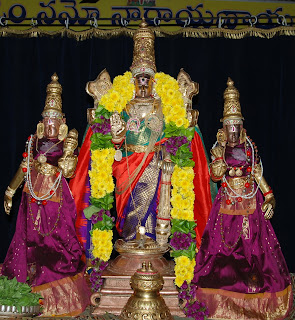
Festivals
Currently, there are festivals on 180days of the year. 
Kalyana Utsavam, Swati Homam and Specific Prarthana Abhishekams are particularly sacred here.
Vaikasi - 10day Narasimha Jayanthi Aippasi 
10day Pavitrotsavam – 4days Lower Ahobilam, 6days Upper Ahobilam 
Thai- Maasi - 45day procession to 33villages around Ahobilam 
Panguni - 12day Brahmotsavam 
Chitrai - Week long utsavam for Pavana Narasimha 

Every month, on the Swathi Nakshatram, there is a special Abhishekam for all the nine Narasimhas

Quick Facts 
Moolavar : Ahobila Narasimha, East Facing Sitting Posture with Prahalada standing opp the Lord
Thaayar : Amruthavalli, Shenjaga Lakshmi 
Utsavar : Narasimha (9 different idols) 
 Azhvaar : Thirumangai Azhvaar (10 Paasurams in Periya Thirumozhi)

 Priest : K.Venugopal (Ramesh) –Chief Archakar @ 94418 02368 or 08519 252097 Ahobila Narasimha Divya Desam- M. Veeraraghava Archagar @ 96032 27118
Time : Upper Ahobilam – Ahobila Narasimha temple 7am-1pm and 2pm-7pm
Lower Ahobilam – Prahalada Varadan temple 630am-1pm and 3pm-8pm 
Other Narasimha temples - 10am-5pm(1pm-2pm rest) 

Where to stay 
Ahobila Mutt has a nice guest house at Lower Ahobilam in front of the Prahalada Varadan temple. For room booking, contact Badri Narayanan-Manager @ 94905 15284 

Vegetarian Food 
There is vegetarian food outside the Ahobilam guest house as well as a Udupi hotel. Temple Thaligai is another option 

How to reach 
By Train Chennai Egmore-Cuddapah (Kacheguda Exp -5pm dep) or Chennai Central-Cuddapah(Bombay mail 1045pm dep). Bus every 30minutes from Cuddapah to Allagadda (84kms- takes 2hours) on the Nandiyal-Kurnool-Hyderabad route. From Arlagadda, one can take another bus to Lower Ahobilam (24kms) - Buses every one hour and takes 30-45minutes. 

A taxi from Cuddapah station to Ahobilam will cost Rs.1500/- (one way) Bus Three direct buses every evening from Chennai Koyembedu bus stand to Allagadda (10hours) via Tirupati-Cuddapah (Kadapa) and return buses from Allagada at 630pm,8pm and 845pm back to Chennai.(Rs.260 per head)

  Lower Ahobilam to Upper Ahobilam A share auto will charge Rs.10per head from Lower to Upper Ahobilam (one can visit Karanja temple on the way).