Sunday, May 13, 2012

Madanagopal set for a big leap as an umpire

A combination of a strong work ethic that has been his trademark during his playing days, a passion for the game (that he has played for  over two decades) and a strong desire to uphold its values, a deep understanding of the rules of the game ( both in terms of the laws as well as the spirit of the game) and most importantly his ability to manage the game through his man-management strengths could see Madanagopal stay long on the international scene as an umpire, provided he receives the right kind of support and backing from the Board in the coming years.
Former Tamil Nadu Ranji Cricketer 37 year old J. Madanagopal is looking to achieve in ‘Umpiring’ what he could not as a player. His next cricketing ambition is to umpire at the highest level of the game while he continues to play cricket at the first division level in Chennai as well as mentor young cricketers.

His tryst with Umpiring began in a most unlikely of chats he had over the phone in what now seems to be a long time ago.

Way back in 2004, when he was playing a Ranji match, J. Madanagopal (Madan) got a surprise phone call from an old Vivekananda college team mate- Prabhu Balachandar (RBI). In the course of that conversation, the RBI player suggested to him to write the umpiring exam as Madan could spend the weekends in a useful way when he was away from playing the Ranji matches. Taking the cue, Madanagopal gave it a shot and got through the examination with ease.

Over the next year, as he began to umpire some of the lower division matches, he realised that he had little knowledge on the finer aspects of umpiring. The turning point came when he attended a session taken by the then chairman of Umpires’ committee Radhakrishnan (Radha).

The passion with which Radha took those classes and the attention to detail immediately motivated Madan to take up umpiring lot more seriously than just the ‘weekend matches’. At the end of that session, Madan decided that he would achieve in umpiring what he could possibly not during his playing days. He quickly moved on to the next level passing through the BCCI conducted examination and made himself eligible to umpire matches that he had in years gone by played in ( Ranji Trophy). In his very first year, umpiring a match involving Bengal, he impressed Sourav Ganguly with some bold decisions.
However, last season (2011-12), he umpired only a couple of Ranji matches. For a former Ranji player who seems to be committed to take up umpiring seriously,   opportunity to umpire just two matches in an entire Ranji season may not be the right kind of encouragement that one would expect from the Board though there seems to be an evaluation metric whereby the performance of all the umpires is monitored and the posting of matches seems to be based on that evaluation.

Madan has a fair knowledge of the game having played years of Ranji Trophy cricket, has been a good leader of men (having led his league team to the shield and helping his ‘young’ team members move up the ladder into the TN Ranji team), is quite articulate with good communication skills and seems to be a ‘learner’ of the game.  He also has a strong work ethic and believes in following the ideals rather than taking short cuts to success.

S Venkataraghavan, who heads the Board (Umpires Committee), refused to comment on Madanagopal and his future prospects citing reasons of being a Board Convener that does not allow him to comment on an individual umpire.

Talking over the phone from Calcutta just ahead of Chennai Super Kings' match against KKR, Kasi Viswanathan, Honorary Secretary, TNCA said, "Madanagopal was an excellent player both for Tamil Nadu and India Cements. As a player, he had a great attitude both on and off the field and that will stand him in good stead as an umpire. Madan is the best 'Cricketer turned Umpire' in the last 10-15years and he has the potential to reach the best in Umpiring. But it would be left to the Umpiring Committee of the BCCI to decide on how he is progressing as an umpire and provide opportunities accordingly."
 
One former cricketer sees him as an ideal coach to groom youngsters given both his knowledge of the game and his communication abilities.  Another cricketer points out that in 2decades of cricket he had not seen Madan dispute an umpiring decision even once, an indication of the respect he has had for the game as a sport and his regard for the umpires and the decisions they make.

For many young cricketers here in Chennai, Madan is one of the first names that spring to their mind even though there does not seem to be a direct connection between those cricketers and him- in terms of playing for the same club and the like. In all the conversations I had there was one common link- the fact that Madan would go out of the way to help out youngsters and guide them on their career. They are also of the view that his prime focus is on a strong work ethic.  

This work ethic is clearly evident when Madan is umpiring. Even when he is umpiring a fifth division match, he is seen at the ground at least 45minutes before the start of the match to perform the pre match duties of an umpire, never mind the fact that he is umpiring an inconsequential lower division match. While he continues to play in the first division league in Madras, on the pretext of keeping himself fit ( though he has the option of not playing and thereby umpiring first division matches in the Chennai league), in the long run, Madan exhibits confidence that he will be able to  officiate at the highest level of the game.

Madanagopal is also one of the very few players from the Tamil Nadu Ranji team of the last 2-3decades who has taken up to Umpiring seriously ( though there has always been the talk of encouraging Former Ranji players to take up umpiring).
It would be interesting to watch as to how the TNCA as well as the BCCI provides support and encouragement for him to succeed in his endeavour. There have been instances of player turned coach, player turned selector and player turned administrator but very few successful examples of player turned umpire because this is one of the most difficult jobs in cricket and has almost always be seen as a thankless job.

On his part, it may be worth evaluating, this very year, the idea of umpiring first division cricket ( as against playing), matches that involve Ranji and Test players such as Badrinath, Dinesh Karthik Abhinav Mukund, Venugopal Rao and Piyush Chawla. For the moment, he seems to be letting got that opportunity in the interest of continuing to play local cricket. But if he is serious about achieving national recognition in umpiring, it may be a sacrifice he will have to make sooner than later for he may have to spend a lot more time on the ground umpiring matches than playing or mentoring.
 
Madanagopal played over 25Ranji matches for Tamil Nadu scoring close to 2000runs. His elder brother Gokulakrishnan also played Ranji cricket and is currently the bowling coach of Tamil Nadu.

Friday, May 11, 2012

Srimushnam Yagya Varaha Swamy Chariot Festival

Chariot Gets stuck on the Mada Street leaving Lord Yagya Varaha Swamy in the hot sun for over 24hours


Chariot Festival at temples in Tamil Nadu this Chitrai has not gone as per plan. And the one that took place last Friday (4May) at the Swayambu Kshetram of Bhoo Varaha Swamy temple in Srimushnum was no different.

By 630am on Friday morning, the Utsava deity Lord Yagya Varahaswamy, along with Sri Devi and Bhoo Devi, was all set for the one day trip on the Chariot. However, it turned out to be a longer day out in the Sun with the unexpected turn of events on Friday.

Starting at 8am, seated atop the chariot, Yagya Varahaswamy began his trip around the four Mada Streets of Sri Mushnam.  While he was expected to be back at the Garuda Mandapa at the temple by the same evening, a slip of the huge chariot at one of the Mada Streets meant that the Lord had to remain in the sweltering 40degree heat for well over 24hours.


It was only by 2pm on Saturday that the chariot was back at the Garuda Mandapa, where one witnessed a special Thiruvanthi Kaapu Vaibhavam.  Later, on Saturday evening, Special abhisheka was performed at the Ahobila Mutt. After a special Alankara, Lord Yagya Varahaswamy made his way from the Ahobila Mutt to the Hanuman temple before reaching his sanctum to bring to end a rather tense Chariot Festival.

Hindu Muslim Unity


A speciality of the Chariot Festival at Srimushnam is that Chariot has a Muslim flag, a symbol of the Hindu- Muslim Unity. In fact, every year in Maasi, the Utsava deity goes on a 20 day procession to Killai and other nearby villages near Chidambaram. An interesting feature of the festival in Maasi is that the Muslims in the area offer prasadams to the Lord Yagya Varaha and they take back the flower of the Lord and offer it to Allah. The Muslim devotees are said to thank Allah for having brought Varaha Swamy to their place.  Bhoo Varaha Swamy temple in Srimushnum is the only temple that brings together such unity between Muslims and Hindus and this event continues to take place to this day.


Unlike typical moolavar deities in Vishnu temples, the Lord here is in the form of a small idol signifying the Varaha Avatar.

Worried that people may turn away from here because of the Lord’s pig face, Bhoodevi requested him to display his handsome stature. Answering her prayers, the Utsava idol features here as Yagya Varahaswamy with a conch and chakra.

Swayambu Kshetram
Srimushnum is one of the 8 Swayambu Kshetrams in India. The others are Srirangam, Tirupathi and Vanamaamalai (Nanguneri) in South India and Saligramam, Naimisarinyam, Pushkaram and Badri in North India. The speciality of the Bhoo Varaha Perumal is that there is a Thirumanjana every day for the Saligrama idol.

Lord’s Five Fingers
While the moolavar idol is a Swayambu moorthy, the temple itself is believed to have been constructed by Four Nayak kings- Achuthappa, Ananthappa, Govindappa and Kondappa Nayak. The story goes that Ananthappa Nayak developed severe stomach pain when they camped at Rajendrapatnam, 8kms East of Sri Mushnum. He was relieved of his pains when Lord Vishnu appeared in his dreams and touched his stomach. Delighted at this, he came here and constructed the temple. To this day, one can see the five fingers of the Lord below his left stomach.

The Pushkarani at the temple was created with the sweat emanating from the Lord’s body after his battle with Hiranyaksha.  Answering Hiranyaksha’s final wish, Bhoo Varaha Swamy turned towards is direction facing South. To this day, the body bearing a human shape is facing West in the direction of the devotees

Inscriptions
Several inscriptions, in Tamil, Telugu and Hindi are found inside the temple on the walls of the outer prakara. 


Friday, April 27, 2012

Kothandarama Temple Ayodhyapattanam

Rama is seen in a Pattabhisheka Kolam

Located about 10kms East of Salem on the Tiruppattur / Athur – Vriddachalam highway is the 17th Century AD Tirumala Nayak period Kothandarama Temple in Ayodhyapattanam.

The Story
The story goes that at the conclusion of the battle with Lankan king Ravana, Rama came here and stayed along with Sita for a day. On the request of Vibheeshana, he is believed to have provided darshan in a Pattabhisheka Posture as a result of which Sita is seen to the left of Rama at this temple. Vibheeshana is seen standing opposite Rama and Sita offering his prayers to them and in a posture of invoking their blessings.

A unique feature at this temple is that Rama is seen in a sitting posture with his left leg placed on his right thigh.

Alongside Rama and Sita inside the sanctum are Lakshmana, Bharata, Shatrugana and Anjaneya.
Architecture
Located on a 1 ½ acre area, the temple was built during the rule of Tirumala Nayak in the 17th Century AD. On the Eastern entrance is a 5 tier 150 feet high Raja Gopuram. As one enters the only prakara of the temple, there is a spacious Maha Mandapa where one finds pillars of good workmanship. One finds several artistic sculptures inside the temple that dates back to the Nayak Period. 
On the North Eastern corner of the mandapa are three musical pillars. Cornices and Horse Pillars are reminiscent of the Madura Style of Tirumala Nayak period. On a single pillar on the Eastern corner are Dasavathara carvings. Four figures carved in the Maha Mandapa are believed to represent Tirumala Nayaka, his wife and two sons. On the upper wall of the Maha Mandapa are several Mooligai Paintings.

Festivals
10day Rama Navami and Hanuman Jayanthi are celebrated in a grand way at this temple.

In centuries gone by, the temple had Vahanas of Anjaneya, Horse and Elephant as well as a palanquin. The 20 feet high wooden chariot is currently in a dilapidated condition.
Quick Facts
Moolavar         : Rama in a Pattabhisheka Kolam with Sita to his left
Utsavar            : Kothandarama
Time                : 7am-12noon and 5pm-830pm
Contact            : Raja Bhattar @98948 70206

How to reach
Train No. 1603 Chennai Egmore- Salem Express stops at Ayodhyapattanam Railway Station (530am).  From Salem Junction, auto will cost Rs. 200-250(one way). Direct buses every 15minutes to the temple from the Salem Old bus stand. One can also take Tirupattur and Athur/ Vriddachalam bound buses to reach Ayodhyappattam ( will take 45minutes from Salem New Bus Stand).

Saturday, April 21, 2012

Kasthuri Ranganatha Perumal Erode


1000 Year Old Ranganatha Temple in the heart of Erode
 Inscriptions date back to 10th Century AD

Located about 2kms from the bus stand is over 1000years old Kasthuri Ranganatha Perumal temple in Erode, a temple that dates back to the rule of Paranthaka Chola.


The Dwarapalakas who were cursed by an angry Sage Durvasa are seen at the feet of Lord Ranganatha offering their service. Lord Kasthuri Ranganatha is seen with his right hand on Sage Durvasa in a posture of cooling the normally angry sage.

Inscriptions


10th Century AD Inscription in Tamil records the construction of a Nilai ( Door Jamb) and mentions the name of the God as Pallikonda Devar

On the Western Wall, an inscription relating to the rule of Raja Kesarivarma mentions the temple of Pallikonda Perumal

Festivals
Chitra Pournami
Brahmotsavam in Puratasi
Garuda Sevai in Panguni, Maasi and Thai

Quick Facts
Moolavar: Kasthuri Ranganatha in a Sayana Kolam
Goddess: Kamalavalli Thaayar
Utsavar : Varadaraja Perumal                                                               
Time : 6am-12noon and 430pm-830pm
Contact: Sriram Bhattar @ 98652 24745 / Nagarajan @ 94439 51121

How to reach
Auto from bus stand will cost Rs. 40 / from the railway station will cost Rs. 50/-


Friday, April 20, 2012

Kodumudi Veera Narayana Perumal


Lord Veera Narayana Perumal prevented floods by turning the Cauvery into an Easterly direction from North 
Parikara Sthalam for different kinds of dosham

Located 40kms off Erode on the Karur Highway in Kodumdi is the Trimurthi Abhimana Sthalam where Lord Shiva is seen in the form of Magudeswara, Vishnu in a sleeping posture as Veera Narayana Perumal and Brahmma beneath a 2000year old Vanni tree.

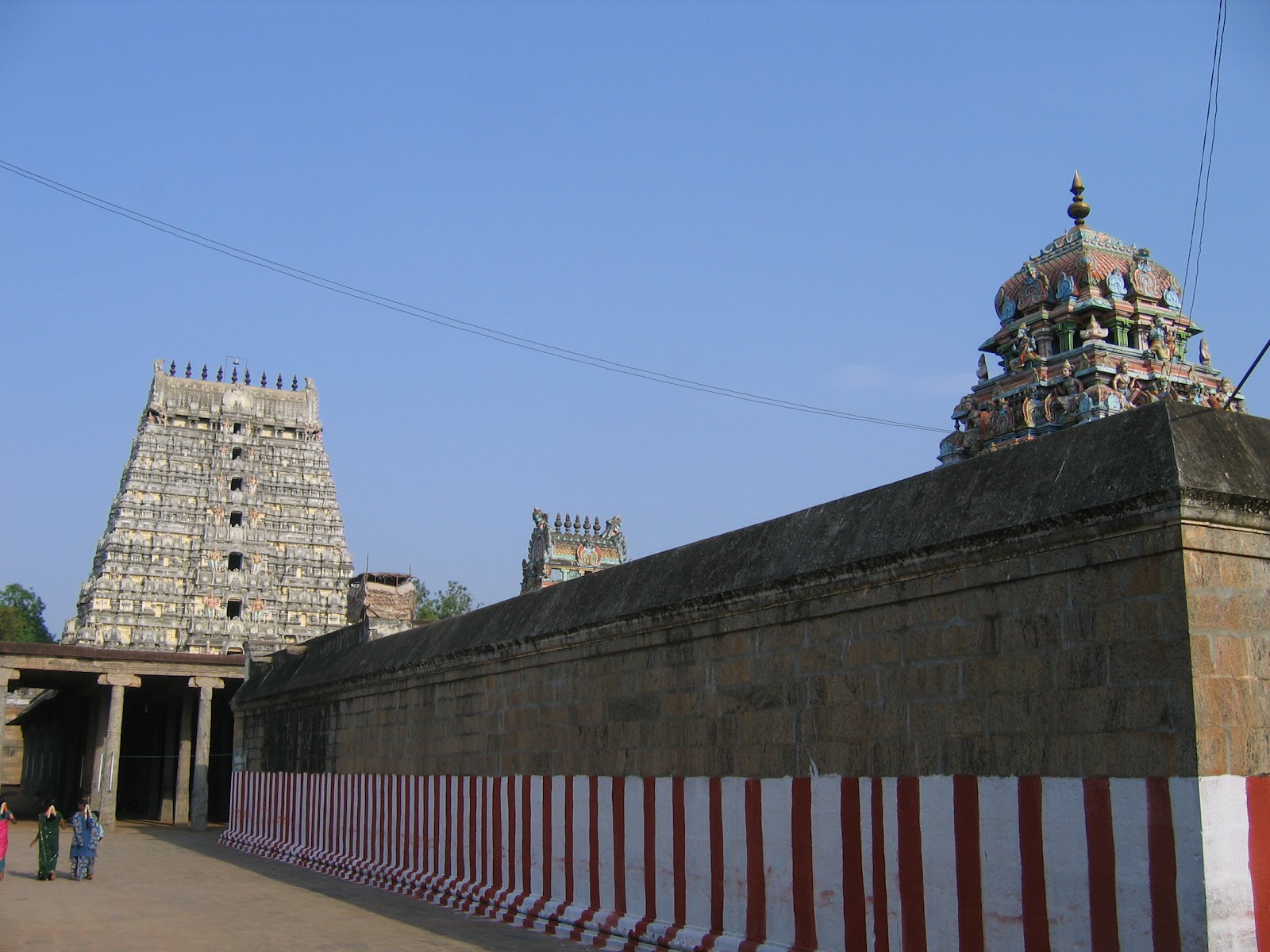
This Trimurthi sthalam is a very important Parikara temple believed to liberate one from different kinds of dosham. There is a separate tower at the Eastern Entrance for each of the Tri Murthies, with Vishnu being in the middle.

Veera Narayana Perumal turns Cauvery’s direction 

Located 40kms off Erode on the Karur Highway in Kodumdi is an Abhimana Sthalam dedicated to the Trimurthies, one where Lord Shiva is seen in the form of a Swayambu lingam, Vishnu in a sleeping posture as Veera Narayana Perumal and  Brahmma beneath a 2000year old Vanni tree. This Trimurthi sthalam is a very important Parikara temple believed to liberate one from different kinds of dosham.

This is one of the four Paadal Petra Sthalams in the Coimbatore District. Thirugnana Sambandar, Thirunavukkarasar and Sundarar visited and composed one Thevaram each about this temple.

There is a separate tower at the Eastern Entrance for each of the Tri Murthies, with the smaller tower for Vishnu being in the middle.

The Story
A fight broke out between Adhisesha and Vaayu to test their powers. Adhisesha coiled around Mount Meru. In retaliation, Vaayu dashed against it and blew it to pieces. Five big clips of Mount Meru fell in different places as five precious stones and each of these became a famous hill sthalam.

Diamond stone became Kodumudi hills, with Lord of Kodumudi alone designing himself as a lingam. In centuries gone by, Shiva was referred to as Thirupandi Kodumudi Mahadeva

Veera Narayana Perumal turns Cauvery’s direction
The story goes that Sage Agastya undertook penance here holding the sacred water of the Ganges in his Kamandala. Indra who had descended in the Chola Kingdom of Sirkazhi undertook pooja invoking the blessings of Shiva to save the people from a famine.

Shiva directed Vinayaka to appear in the form of a white crow and spill the sacred water at this place causing floods around Kodumudi.  Lord Veera Narayana Perumal is believed to come here and turned the direction of this sacred water (River Cauvery) away from the town of Kodumudi. Hence, while the Cauvery is seen in a North South direction till here, interestingly it takes an Easterly turn from North at this place. This incident is commemorated on a rock known as Agastya Paarai. Vinayaka is referred to as Cauvery Kanda Vinayaka.

Another story goes that Bharadwaja rishi took bath here on the Cauvery river banks and worshipped Magudeswara. Pleased with his prayers, Lord Shiva provided darshan in a dance posture accompanied by a Grand Orchestra. Hence this place is also referred to as Bharadwaja Kshetram.

Alongside Veera Narayana Perumal inside the sanctum of Vishnu are Garuda, Anjaneya, Narada, Brahmma, Vasudeva and Vibheeshana.

Sun’s rays of Lord Shiva
Sun’s rays falls on Lord Shiva and Amman on four days in Panguni and Avani indicating offering of pooja by the Sun God to Shiva.

Construction of Mandapas and Pagodas
Pleased with the growth of thumb of his son, which was originally defective, Malayadwaja Pandya constructed three Pagodas, Mandapas and also established a mutt and a choultry at this place.  He also gifted a big and beautiful temple car, endowed villages and made jewellery for the deities in a thanking gesture to the Trimurthies.

Ramayana Story
Ramayana Story relating to Vishwamitra’s Yagna, killing of Thaadagai, liberation of Ahalya’s curse and Rama Pattabhishekam is seen on the upper walls in the mandapa in front of the sanctum in the form of beautiful mini sculptures.

On the third pillar of the prakara, one finds a special type of Vinayaka- Vinayaka’s Swaroopa, Sakthi’s Hamsam and Tiger’s legs.

Pandya kings are believed to have undertaken renovation of the temple, in recognition of which one finds the Pandyan Kondai in front of the Garuda Sannidhi.

Parikara Sthalam

This is an important Parikara Sthalam for liberation from all kinds of Dosham. Unmarried people are believed to find their spouse after they perform parikara pooja at this temple. This is also a parikara sthalam for improvement in business and career prospects. Worshipping Shiva during Pradhosham days is very sacred at this temple.

Devotees carrying Kaavadi to Palani have bath here at Cauvery before proceeding to Palani.

Specifically this is a temple for liberation from Avittam star dosham.

Inscriptions
7th Century Inscriptions indicate renovation of the temple by Narasimma Pallava. There are two lion faced stone pillars as a testimony to his contribution. An 8th Century inscription indicates donation by Thermaaran of gold coins, jewels and ornaments to the temple. Malayathu Pandya donated villages towards the upkeep of the temple. Komara Varma gifted things towards Thirumanjana on Thiruvathirai Star

11th Century AD stone inscription on the Cauvery banks in Tamil refers to a gift of gold for food offerings.

On the Northern wall is a record of tax free gift of villages fixing income from same in gold and paddy to God to meet expenses of offerings, worship and celebrating star of the king and Maasi Magam

13th Century AD inscriptions indicate gifting of land by Sundara Pandya Kesarivarma

On the back of the Ardha Mandapa in front of Amman Shrine refers to the setting up images of Ilaya Pillayar (Subramanya) an d Garuda and a grant of 5pon to meet expenses of worship.

 Festivals
Aadi Perukku is a special occasion when devotees have sacred bath at the Cauvery
Aani Jeshtabhishekam- Once in a year Moolavar Thirumanjana with Sandalwood oil paste
Horse Vahana procession in Puratasi
3day Utsavam in Margazhi
11day Brahmotsavam in Chitrai including Chariot Festival in Hastham

Quick Facts

Deity                : Veera Narayana Perumal East Facing Sayana Kolam
Goddess           : Veera Lakshmi/ Thirumangai Nachiyar
Temple Time     : 6am-12noon and 330pm-8pm
Contact            : Sridhar Bhattar @94881 43403/93605 01970.04204 222020

How to reach
6107 Chennai Mangalore Express Stops at Kodumudi (7am)
From Erode, One can reach Kodumudi in one hour by bus and within 45minutes by bus from Karur.